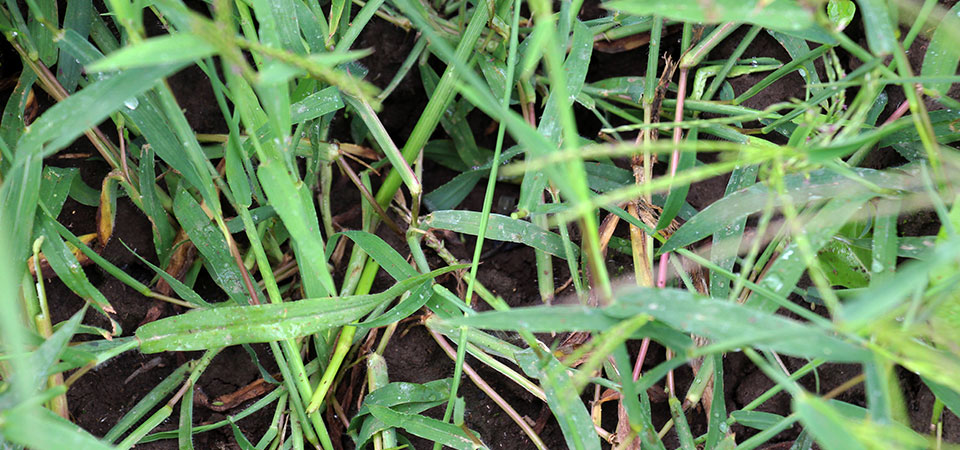
Crabgrass preventers should be applied before the weed germinates, typically around May 1.
Lawn got you crabby? Time nears to apply preventers
K-State horticulture expert explains best practices for treating crabgrass
At a glance: Applying herbicide in April can help to prevent crabgrass problems in home lawns, said K-State horticulture expert Cynthia Domenghini.
More information: Cynthia Domenghini, Cdom@ksu.edu
Related: K-State Horticulture Newsletter | Weed Control in Home Lawns | Planting a Home Lawn | Fertilizing Kansas Lawns
March 25, 2025
K-State Research and Extension news service
MANHATTAN, Kan. — A weed commonly found in Kansas lawns can sure make homeowners feel pretty crabby this time of year.
But applying an herbicide at the right time can help alleviate crabgrass problems, said Kansas State University horticulture expert Cynthia Domenghini.
“For most of Kansas, crabgrass typically begins to germinate around May 1 or a little later,” Domenghini said. “April 15 is normally a good target date for applying crabgrass preventer because it gives active ingredients time to evenly disperse in the soil before germination starts.”
Crabgrass preventers are another name for pre-emergence herbicides that prevent crabgrass seeds from developing into mature plants. “They do not kill the weed seed or even keep the seed from germinating, but rather kill the young plant after it germinates,” Domenghini said.
She added that most crabgrass preventers have no effect on existing plants, “so they must be applied before germination.”
“Preventers do not last forever once applied to the soil. Microorganisms and natural processes begin to gradually break them down soon after they are applied. If some products are applied too early, they may have lost much of their strength by the time they are needed.”
Domenghini said most crabgrass preventers are fairly ineffective after 60 days.
“Work with your local extension agency to decide which pre-emergence is right for you and determine when it should be applied,” she said. “In general, the proper time to apply a crabgrass preventer usually falls the same time that the Eastern Redbud tree – known for its pretty pink flowers -- is in full bloom.”
“We recommend homeowners apply crabgrass preventers before fertilizer so the grass isn’t encouraged to put on too much growth too early,” Domenghini said. “However, it may be difficult to find pre-emergent products without fertilizer.”
Domenghini and her colleagues in K-State’s Department of Horticulture and Natural Resources produce a weekly Horticulture Newsletter with tips for maintaining home landscapes and gardens.
Interested persons can subscribe to the newsletter, as well as send their garden and yard-related questions to hortsupport@ksu.edu, or contact your local K-State Research and Extension office.
***

K‑State Research and Extension is a short name for the Kansas State University Agricultural Experiment Station and Cooperative Extension Service, a program designed to generate and distribute useful knowledge for the well‑being of Kansans. Supported by county, state, federal and private funds, the program has county extension offices, experiment fields, area extension offices and regional research centers statewide. Its headquarters is on the K‑State campus in Manhattan. For more information, visit www.ksre.ksu.edu. K-State Research and Extension is an equal opportunity provider and employer.