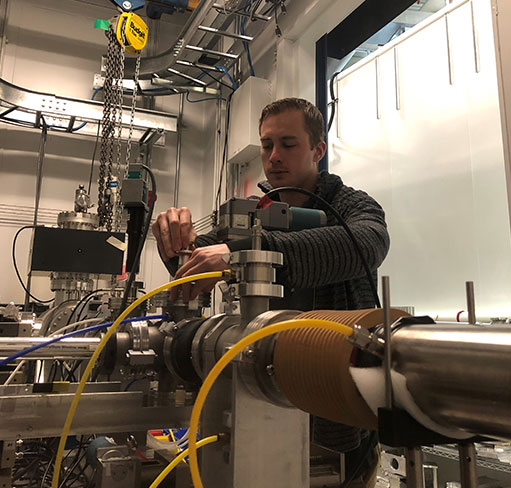
Jay Weeks, who recently completed doctoral work at Kansas State University, sets up soil samples as part of a recent research project.
K-State researchers test fertilizers for best results in Kansas, other soils
Liquid fertilizers are best in calcareous soils, they say
March 5, 2020
MANHATTAN, Kan. – Ganga Hettiarachchi knows that farmers want to be good stewards of the environment. And as a soil scientist at Kansas State University, she is in a good position to help them along the way.
Hettiarachchi and former doctoral student Jay Weeks recently completed a study of how phosphorus – an important nutrient for growing farm crops – reacts in alkaline farmland, called calcareous soils, which are abundant in arid to semiarid regions, due to their high concentrations of calcium and carbonate
Because plant available phosphorus is often lacking in calcareous soils, one tendency is to over-apply fertilizer to make sure that crops have enough phosphorus available to meet its growth needs.
But Hettiarachchi said more may not be better when applying fertilizer in calcareous soil, such as those found in many parts of western Kansas.
“Our research group conducted experiments in a laboratory to understand exactly what is happening to the phosphorus when fertilizer is applied to crops,” Hettiarachchi said.
What they found is that when fertilizer is applied in granules, the phosphorus is readily converted into calcium phosphate and not available to the plant. In that case, Hettiarachchi said, precipitated phosphorus could eventually move across the soil and into adjacent waterways.
Instead, she said, farmers should apply smaller amounts of liquid fertilizers, or other phosphorus sources, such as ammonium polyphosphate (APP). Those products are more capable of permeating the soil, minimizing calcium phosphate precipitation and delivering phosphorus and other nutrients to the plant.
“By selecting the right source and formulation,” Hettiarachchi said, “they could actually save money by applying less phosphorus. That is good for the farmers economically and good for the environment because we are not over-applying phosphorus.”
Hettiarachchi noted her group’s findings support a well-known principle of responsible nutrient management that calls for applying nutrients at the right time, rate, source and place. “I think that is the driving thing for farmers…they want to do this right,” she said.
“The bottom line is that when considering granule fertilizers or liquid fertilizers in calcareous soils, it matters which one you use,” Hettiarachchi said. “We need to use the right source so that we don’t over-apply fertilizer.”
Hettiarachchi’s work, which studied soils found near Garden City, Kan., was recently accepted for publication in the journal for the Soil Science Society of America.
She added that future work will study the impact of other nutrients common in fertilizer. “We are looking at ways of developing more efficient fertilizers,” Hettiarachchi said. “Again, it goes back to finding the right source so you can do more with less.”
NOTE: This research was funded by the USDA’s National Institute of Food and Agriculture, Hatch-Multistate project 1007915 and private industry.