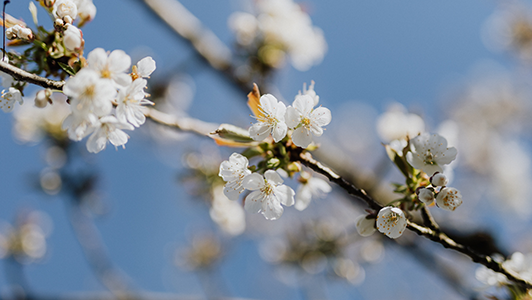
The closer a fruit tree is to blooming, the more sensitive it is to frost damage, said K-State horticulture expert Ward Upham.
Preventing frost damage to fruit trees this spring
K-State horticulture expert explains fruit tree species' sensitivity to frost
Jan. 12, 2023
By Maddy Rohr, K-State Research and Extension news service
MANHATTAN, Kan. — As fruit tree selection begins for the spring, Kansas State University horticulture expert Ward Upham said certain species will be more sensitive to frost and, thus, decreased fruit production.
“Spring in Kansas is often unsettled with apricot and peach tree flowers being very vulnerable to late frosts that can kill fruit buds,” Upham said. “Of course, the tree itself will be fine, but there will be none to little fruit for that year.”
Upham said the closer a tree is to blooming the more sensitive it is, but apricot and peach trees are by far the most vulnerable.
“Apricots are more likely to have frost kill flowers than peaches because they bloom a bit earlier. Though there are late-blooming apricot varieties, the differences between full bloom on early and late-blooming varieties appears to be slight,” Upham said.
In addition to bloom time, fruit bud hardiness is important in peach tree varieties.
“In this case, fruit bud hardiness refers to hardiness to late frosts rather than the ability to survive extreme low temperatures during the winter,” Upham said.
Location is also a factor in preventing frost damage to fruit trees. Upham recommends planting on a hill that allows cold air to drain to lower elevations, or a location in town that will be more likely to have a warmer micro-climate than an exposed location.
“Some gardeners will add a heat source under a tree during cold nights if they are close to a building,” Upham said. “Heat lamps and charcoal briquettes are sometimes used but safety should be the first consideration.”
Upham and his colleagues in K-State's Department of Horticulture and Natural Resources produce a weekly Horticulture Newsletter with tips for maintaining home landscapes and gardens. The newsletter is available to view online or can be delivered by email each week.
Interested persons can also send their garden and yard-related questions to Upham at wupham@ksu.edu, or contact your local K-State Research and Extension office.