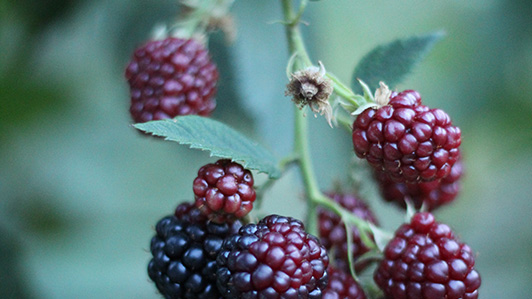
Raspberry and blackberry plants are perennial, but the canes are biennial, which means they are likely to die after the second year of producing fruit.
Pruning raspberry and blackberry canes will help with plant health
K-State horticulture expert gives tips for removing dead canes
March 16, 2023
By Maddy Rohr, K-State Research and Extension news service
MANHATTAN, Kan. — Pruning perennial plants helps prepare them for regrowth and fruit production, but raspberries and blackberries are unique. The plant is perennial, but the canes are biennial, said Kansas State University horticulture expert Ward Upham.
“In other words, a single plant will last many years but an individual cane will only live for two,” Upham said. “In a cane’s first year, it will grow but will not produce fruit. The second year, it will fruit and then die.”
Upham said dead canes are not difficult to identify, as they are much lighter in color, dry and brittle.
“These canes should be removed and discarded. The remaining canes should be thinned,” Upham said.
The type of plant growth determines how the plant should be thinned, he said.
Black and purple raspberries and thornless blackberries
Upham said this growth tends to grow in a clump. He recommends removing all the canes but five to seven of the largest and healthiest in each clump. Then, cut back the remaining canes to living tissue if there was winter damage.
“With black raspberries, 8-10 buds per side shoot is enough. Cut laterals back to leave the recommended number of buds,” Upham said. “Purple raspberries and thornless blackberries are more vigorous than black, so leave a few more buds per lateral.”
Upham said thornless blackberries will also produce a few buds that come up some distance from the clump. These should be removed or dug and transplanted to increase the planting.
Red raspberries and thorny blackberries
“These two sucker badly and will fill the row with new plants,” Upham said.
Upham recommends pruning small canes within the row so that there are strong canes 4-6 inches apart. Head back all the remaining canes to about five feet.
“There is no need to prune back any laterals present. Keep aisles free of new suckers during the summer by mowing,” Upham said.
Everbearing red raspberries and blackberries
“These are the exception to the rule in that they will bear fruit on first-year canes,” Upham said.
Upham suggests cutting all canes to the ground in the winter and you will still have fruit. Examples include Heritage red raspberry and Prime-Jim, Prime-Jan, Prime Ark 45 and Prime Ark Freedom blackberries.
Upham and his colleagues in K-State's Department of Horticulture and Natural Resources produce a weekly Horticulture Newsletter with tips for maintaining home landscapes and gardens. The newsletter is available to view online or can be delivered by email each week.
Interested persons can also send their garden and yard-related questions to Upham at wupham@ksu.edu, or contact your local K-State Research and Extension office.