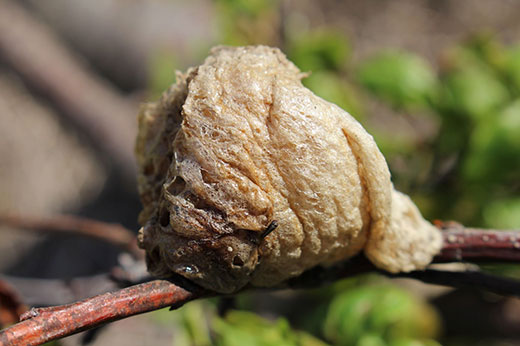
A praying mantid egg case (pictured) is a good sign for home gardeners. The predators are guardians of the garden, routinely feasting on undesirable insects. (Photo courtesy of Raymond Cloyd, K-State Research and Extension)| Download this photo
Good for the Garden: Praying mantids prey on insects
K-State entomologist shares why and how these insects should be kept in the home garden
April 19, 2023
K-State Research and Extension news service
MANHATTAN, Kan. - A natural way to keep gardens safe from hungry pests is to employ the help of praying mantids. K-State entomologist Raymond Cloyd said this top predator of the insect world can be beneficial to a home garden.
“They eat anything they can grab onto with their raptorial front legs,” Cloyd said, “including flies, crickets, moths, butterflies, wasps and caterpillars.”
He said home gardeners can keep an eye out for praying mantis egg cases between November and April. They appear as a hardened, Styrofoam-like egg case, and can stick to branches, stems, walls, fences, sides of houses and eaves.
Just-hatched mantids, called nymphs, will emerge 3-10 weeks after the eggs are laid.
“Nymphs that emerge in spring resemble miniature adults,” Cloyd said. “However, not all the nymphs will survive to become adults because they are susceptible to predation by birds, toads, lizards and predacious insects.”
To ensure the garden has a few praying mantid guardians, their egg cases can be preserved. To do so, Cloyd suggests:
- Remove the egg case and place it into a glass jar with a lid that has at least 10 small air holes. The glass jar should be kept in the home around warm temperatures.
- Wait 4-6 weeks for eggs to hatch. To delay hatching, place the jar into the refrigerator and remove 1-2 months before the desired hatching date.
- Once nymphs hatch, immediately release them into the garden where they will feed. Do not release nymphs to freezing temperatures or they will die.
If no praying mantid egg cases can be found in the garden, Cloyd recommends purchasing them from garden centers, nurseries or other mail sources.
Cloyd and his colleagues in K-State’s Department of Horticulture and Natural Resources produce a weekly Horticulture Newsletter with tips for maintaining home landscapes. The newsletter is available to view online or can be delivered by email each week.
Interested persons can also send their garden- and yard-related questions to Ward Upham at wupham@ksu.edu, or contact your local K-State Research and Extension office.