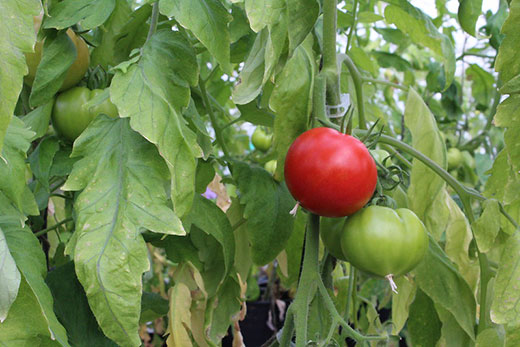
K-State horticulture expert Ward Upham said cracking early in the season is likely related to the top growth of the tomato, which can result in blossoms.
Tomato Cracking: Is it Preventable?
Choose different varieties to prevent common problem, says K-State expert
July 19, 2023
MANHATTAN, Kan. — Home gardeners often face the problem of tomato cracking, or hard cracks on the upper part of the fruit, usually spanning from or around the stem.
While the cracks do not necessarily ruin the tomato, they are unsightly, said Kansas State University horticulture expert Ward Upham.
“Tomatoes have a root system that is very dense and fibrous, and is quite efficient in picking up water,” he said. “Unfortunately, the root system can become unbalanced with the top of the plant.”
Upham said cracking early in the season is likely related to the top growth of the tomato, which can then result in blossom-end rot when the weather turns hot and dry. Later in the season, cracking may be caused by a sudden abundance of water after a long dry spell.
How can cracking be prevented? Upham suggests consistent watering and mulching. Scheduled watering will prevent a quick influx of water likely to cause cracking. Additionally, mulching will help moderate moisture levels in the soil.
Some gardeners may be already following these recommendations and doing everything right, and still end up with tomato cracking. Upham and his colleagues in K-State’s Department of Horticulture evaluated different tomato varieties over several years to try and come up with the most crack-resistant tomato.
“The difference seems to be the pliability of the skin rather than thickness; the more pliable the skin, the more resistance to cracking,” Upham said. “The old variety Jet Star has been the most crack resistant of any we have tested, including the newer types.”
Unfortunately, Upham noted, Jet Star is a variety that can put out rampant, uncontrolled growth. Of the newer, more attractive varieties, Upham said the Mountain Spring, Mountain Pride, Mountain Fresh, Floralina, and Sun Leaper varieties had good resistance to cracking.
Upham and his colleagues in K-State's Department of Horticulture and Natural Resources publish a weekly Horticulture Newsletter with tips for maintaining home landscapes. The newsletter is available to view online or can be delivered by email each week.
Interested persons can also send their garden- and yard-related questions to Upham at wupham@ksu.edu, or contact your local K-State Research and Extension office.